
 APMG
APMG
What is a Modelling Artist in the VFX Industry and How to Become One in India?
Discover the role of a Modelling Artist in VFX, their responsibilities, skills, salary, software expertise, and a step-by-step guide to building a successful career in India.
The visual effects (VFX) industry has transformed the way audiences experience movies, television shows, advertisements, and video games. From creating realistic creatures and futuristic vehicles to designing entire digital cities, VFX professionals play a crucial role in bringing imagination to life. Among these specialists, the Modelling Artist is one of the most important contributors to the production pipeline.
Every object, character, building, or environment seen in a VFX-heavy movie begins with a model. Whether it is a superhero character, a fantasy creature, a spaceship, or a detailed cityscape, a modelling artist is responsible for creating its digital form. As India's animation and VFX industry continues to grow rapidly, the demand for skilled modelling artists is increasing across studios, gaming companies, OTT platforms, and advertising agencies.
If you are passionate about art, design, and 3D creation, a career as a modelling artist can be both creatively fulfilling and financially rewarding. In this guide, we will explore what a modelling artist does, the skills required, career opportunities, salary prospects, and how to become a modelling artist in India.
What is a Modelling Artist?
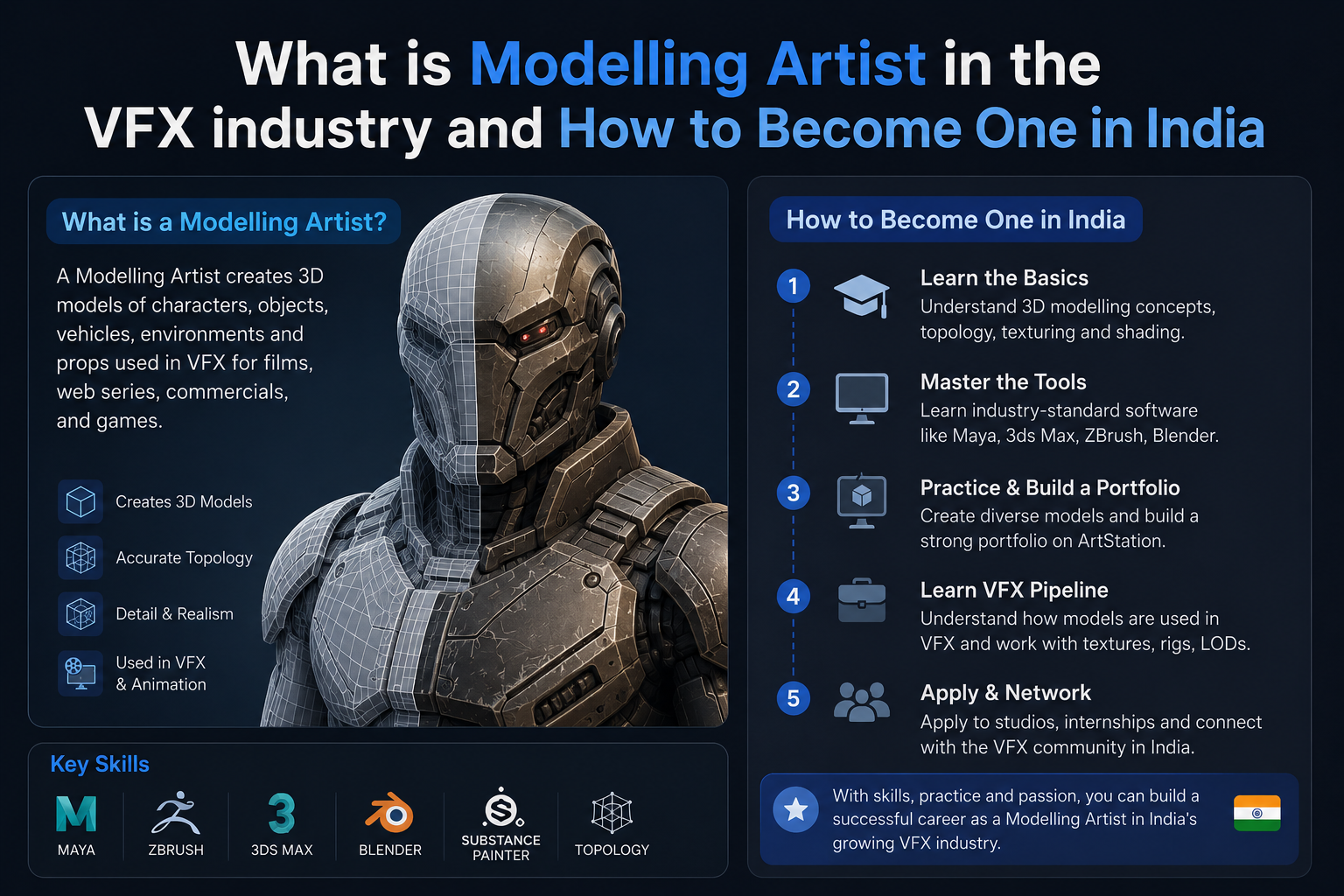
A Modelling Artist is a 3D professional who creates digital models of characters, objects, environments, vehicles, props, and other assets used in films, television, animation, games, and visual effects projects.
Using specialized 3D software, modelling artists transform concepts, sketches, photographs, and references into detailed three-dimensional assets. These models serve as the foundation for texturing, rigging, animation, lighting, and rendering departments.
Simply put, if an object appears in a digital scene, it first needs to be built by a modelling artist.
What Does a Modelling Artist Do?
A modelling artist's responsibilities vary depending on the project and studio requirements. However, some common tasks include:
Creating 3D Assets
The primary responsibility is to build accurate and detailed 3D models based on concept art, blueprints, or references.
Character Modelling
Creating human, animal, creature, or fantasy character models for films, games, and animation projects.
Environment Modelling
Designing landscapes, buildings, cities, forests, interiors, and virtual worlds.
Hard Surface Modelling
Building mechanical objects such as vehicles, robots, weapons, machinery, and architectural structures.
Maintaining Topology
Ensuring clean geometry and proper polygon flow for animation and production purposes.
Collaborating with Other Departments
Working closely with texture artists, riggers, animators, and VFX supervisors to ensure models meet project requirements.
Updating and Refining Models
Making revisions based on client feedback and production needs.
Importance of Modelling Artists in the VFX Pipeline
Modelling is often one of the earliest stages of VFX production. Without accurate and well-built models, subsequent departments cannot perform their work effectively.
Modelling artists contribute to:
- Character creation
- Creature development
- Set extensions
- Virtual production
- Product visualization
- Digital doubles
- Gaming assets
- Architectural visualization
Their work directly influences the quality and realism of the final output.
Types of Modelling Artists
Depending on specialization, modelling artists may focus on different areas.
Character Modeller
Creates realistic or stylized characters for films, games, and animation.
Creature Modeller
Designs animals, monsters, aliens, and fantasy creatures.
Environment Modeller
Builds landscapes, cities, forests, and architectural structures.
Hard Surface Modeller
Specializes in mechanical and man-made objects like vehicles and machinery.
Prop Modeller
Creates smaller objects such as furniture, weapons, gadgets, and accessories.
Digital Sculptor
Uses sculpting software to create highly detailed characters and assets.
Skills Required to Become a Modelling Artist
To succeed as a modelling artist, you need a combination of artistic creativity and technical expertise.
Strong Observation Skills
Artists must study real-world objects and accurately recreate them in 3D.
Understanding of Form and Structure
Knowledge of shape, volume, proportions, and anatomy is essential.
Creativity
The ability to visualize and create original designs helps artists stand out.
Attention to Detail
Small details significantly impact the realism and quality of models.
Problem-Solving Ability
Artists often face technical and creative challenges during production.
Knowledge of Topology
Clean topology ensures models work correctly during animation and rendering.
Communication Skills
Collaboration is a key part of the VFX production pipeline.
Software Used by Modelling Artists
Professional modelling artists use industry-standard software to create assets.
Autodesk Maya
One of the most widely used software packages in the VFX industry.
Blender
A free and powerful 3D creation tool ideal for beginners and professionals.
ZBrush
Industry-leading software for digital sculpting and high-detail modelling.
Autodesk 3ds Max
Commonly used in gaming and architectural visualization.
Houdini
Useful for procedural modelling and complex simulations.
Substance Painter
Used for texturing and adding realistic surface details.
Unreal Engine
Increasingly used for real-time asset creation and virtual production.
Learning multiple tools can significantly improve job opportunities.
Educational Qualifications Required
One of the best aspects of the VFX industry is that skills matter more than academic degrees.
You can pursue a modelling artist career after:
- Completing Class 12
- Diploma in Animation or VFX
- Bachelor's degree in Animation, Multimedia, Fine Arts, or Design
- Professional certification programs
Most employers focus on portfolios rather than educational qualifications.
How to Become a Modelling Artist in India
Step 1: Learn the Basics of 3D Art
Start by understanding:
- Shapes and forms
- Perspective
- Anatomy
- Design principles
- Composition
A strong artistic foundation helps create better models.
Step 2: Master 3D Modelling Software
Begin with beginner-friendly software such as Blender or Maya.
Focus on:
- Polygon modelling
- Sculpting
- UV mapping
- Topology
- Asset optimization
Practice regularly to improve speed and accuracy.
Step 3: Study Real-World References
Observe objects, architecture, people, and nature carefully.
Reference-based modelling helps artists achieve realism and accuracy.
Step 4: Create Personal Projects
Develop original projects such as:
- Character models
- Fantasy creatures
- Vehicles
- Buildings
- Environment scenes
Personal projects demonstrate creativity and technical skills.
Step 5: Build a Professional Portfolio
A portfolio is your most important career asset.
Include:
- High-quality renders
- Wireframe views
- Turntable animations
- Character sculpts
- Environment models
Quality is more important than quantity.
Step 6: Learn Industry Workflows
Understand how modelling integrates with:
- Texturing
- Rigging
- Animation
- Lighting
- Rendering
Knowledge of the full pipeline makes you a stronger candidate.
Step 7: Apply for Internships
Internships provide practical experience and industry exposure.
Look for opportunities at:
- Animation studios
- VFX companies
- Gaming studios
- Advertising agencies
Step 8: Start with Entry-Level Roles
Common beginner positions include:
- Junior Modelling Artist
- 3D Artist
- Asset Artist
- Character Modeller
- Environment Artist
Experience gained in these roles helps accelerate career growth.
Salary of a Modelling Artist in India
Salary depends on skills, experience, portfolio quality, and location.
Entry-Level Modelling Artist
- ₹3 LPA to ₹6 LPA
Mid-Level Modelling Artist
- ₹6 LPA to ₹12 LPA
Senior Modelling Artist
- ₹12 LPA to ₹20 LPA+
Freelance Modelling Artist
Freelancers may earn project-based income ranging from thousands to lakhs depending on complexity and client requirements.
Professionals working with international studios often earn significantly higher compensation.
Career Opportunities for Modelling Artists
Modelling artists can work across various industries.
VFX Studios
Create digital assets for movies and television productions.
Gaming Industry
Design characters, weapons, vehicles, and game environments.
Animation Studios
Build assets used in animated films and series.
Advertising Agencies
Create product visualizations and promotional content.
Architectural Visualization
Develop realistic building and interior models.
Virtual Reality and Augmented Reality
Design interactive 3D experiences and virtual environments.
Future Scope of Modelling Artists in India
India's animation, VFX, gaming, and comics (AVGC) sector is experiencing tremendous growth. The increasing demand for OTT content, gaming experiences, virtual production, and immersive technologies has created a strong need for skilled 3D artists.
Emerging technologies such as:
- Virtual Production
- Artificial Intelligence
- Metaverse Applications
- Augmented Reality
- Real-Time Rendering
are generating new opportunities for modelling artists.
Professionals who continuously upgrade their skills can expect excellent career growth in the coming years.
Challenges of Being a Modelling Artist
Like any creative profession, modelling comes with challenges.
- Tight deadlines
- High-quality expectations
- Continuous software updates
- Detailed revision cycles
- Long project hours
However, artists who enjoy creating digital worlds often find the work highly rewarding.
Conclusion
A Modelling Artist is the backbone of the VFX production pipeline. From creating realistic characters and creatures to building massive digital environments, modelling artists transform ideas into three-dimensional assets that bring stories to life.
For aspiring creative professionals in India, modelling offers an exciting career path with opportunities in VFX, animation, gaming, advertising, and emerging technologies. By learning industry-standard software, mastering artistic fundamentals, building a strong portfolio, and gaining practical experience, you can establish yourself as a successful modelling artist in the rapidly growing AVGC industry.
As demand for high-quality digital content continues to rise in 2026 and beyond, skilled modelling artists will remain among the most sought-after professionals in the world of visual effects and digital entertainment.


