
 APMG
APMG
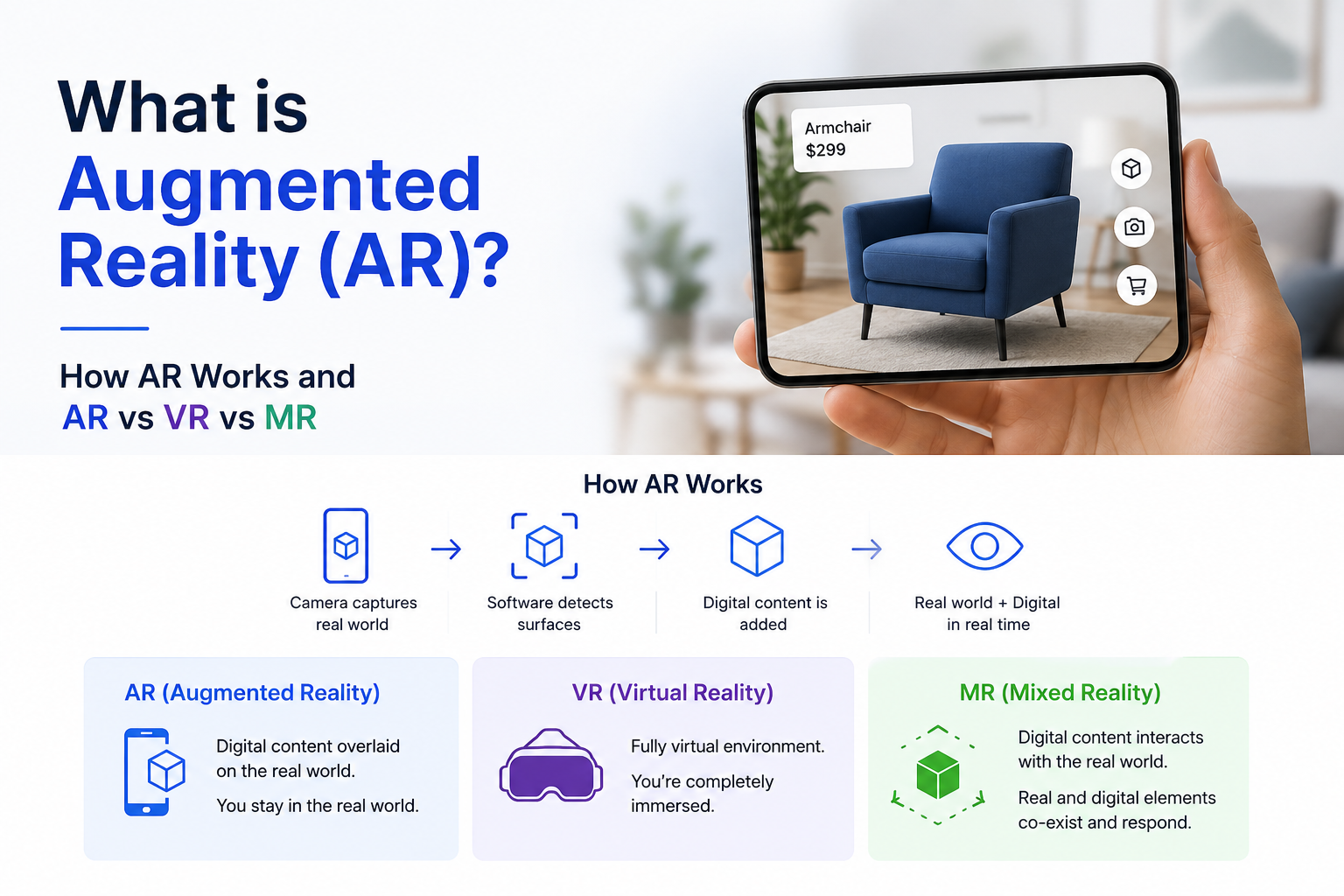
What is Augmented Reality (AR)? How it Works and AR vs. VR vs. MR
Augmented Reality (AR) is transforming industries by blending digital elements with the real world in real time. This blog explains what AR is, how it works using technologies like sensors, AI, and computer vision, and explores its applications in gaming, healthcare, education, retail, and more. It also compares AR with Virtual Reality (VR) and Mixed Reality (MR), helping readers understand the differences, advantages, limitations, and future potential of immersive technologies in 2026.
Technology is evolving faster than ever, and one of the most exciting innovations transforming industries today is Augmented Reality (AR). From gaming and education to healthcare, retail, architecture, and entertainment, AR is changing how people interact with digital content in the real world.
In 2026, Augmented Reality is no longer just a futuristic concept. Businesses, creators, developers, and even students are actively using AR technologies to create immersive experiences. Popular apps like Snapchat filters, Pokémon GO, IKEA Place, and virtual makeup try-ons have already introduced millions of people to AR in everyday life.
At the same time, terms like Virtual Reality (VR) and Mixed Reality (MR) are becoming increasingly popular. Although these technologies are related, many people still get confused about the differences between AR, VR, and MR.
This guide explains:
- What Augmented Reality is
- How AR works
- Types of AR technology
- Real-world applications of AR
- Advantages and limitations
- Differences between AR, VR, and MR
- Future of immersive technologies in 2026
What is Augmented Reality (AR)?
Augmented Reality (AR) is a technology that overlays digital content such as images, animations, sounds, or 3D objects onto the real-world environment in real time.
Unlike Virtual Reality, which completely replaces the real environment with a virtual one, AR enhances the real world by adding digital elements to it.
For example:
- Snapchat filters place virtual effects on faces
- Pokémon GO adds virtual characters into real streets
- Furniture apps allow users to place digital sofas inside their homes
- Navigation apps display directions on live roads
In simple words, AR combines the physical world and digital content together.
How Does Augmented Reality Work?
AR works by using hardware and software technologies that analyze the real-world environment and then place digital elements within it.
The process happens in real time using cameras, sensors, processors, and AR software.
Step-by-Step Working of AR
1. Environment Detection
The AR device first scans the surroundings using:
- Cameras
- GPS
- Depth sensors
- Motion trackers
The system collects information about surfaces, lighting, objects, and movement.
2. Data Processing
After scanning the environment, AR software processes the collected data using:
- Computer vision
- Artificial intelligence
- Machine learning
- Spatial mapping
This helps the device understand where digital objects should appear.
3. Digital Object Placement
The system overlays digital content onto the real-world environment.
Examples include:
- 3D furniture models
- Animated game characters
- Navigation arrows
- Interactive product displays
The digital objects move naturally according to the user’s perspective and motion.
4. Real-Time Interaction
Users can interact with the AR environment using:
- Touch screens
- Voice commands
- Hand gestures
- Motion tracking
The interaction happens instantly, creating an immersive experience.
Technologies Used in AR
Several technologies work together to make AR possible.
Cameras and Sensors
These capture real-world information and user movements.
Computer Vision
Computer vision helps AR systems recognize objects, surfaces, and environments.
Simultaneous Localization and Mapping (SLAM)
SLAM technology helps devices map surroundings while tracking user movement simultaneously.
Artificial Intelligence (AI)
AI improves object recognition, facial tracking, and scene understanding.
AR SDKs and Software
Developers use software development kits (SDKs) like:
- ARCore
- ARKit
- Vuforia
- Unity
- Unreal Engine
to create AR applications.
Types of Augmented Reality
AR technology can be divided into several categories.
Marker-Based AR
This type uses specific markers or QR-code-like patterns to trigger AR content.
Example:
- Scanning a product package to display 3D animations
Markerless AR
Markerless AR uses GPS, cameras, and sensors instead of markers.
Examples:
- Pokémon GO
- AR navigation apps
This is one of the most widely used AR types today.
Projection-Based AR
This technology projects digital light onto physical surfaces.
Example:
- Interactive keyboards projected onto tables
Superimposition AR
This replaces part of the real-world view with digital content.
Example:
- Virtual furniture placement apps
Applications of Augmented Reality
AR is now used across multiple industries.
1. Gaming Industry
Gaming is one of the biggest AR sectors.
Popular examples:
- Pokémon GO
- AR mobile games
- Interactive gaming environments
AR gaming combines real surroundings with digital experiences.
2. Retail and E-Commerce
Retail brands use AR to improve online shopping experiences.
Examples:
- Virtual try-ons for makeup and glasses
- Furniture placement previews
- Virtual fitting rooms
Customers can visualize products before buying.
3. Education
AR makes learning more interactive and engaging.
Students can:
- Explore 3D anatomy models
- Visualize planets and science concepts
- Interact with historical objects
AR improves understanding through visualization.
4. Healthcare
Doctors and medical students use AR for:
- Surgical guidance
- Anatomy training
- Medical simulations
- Patient education
AR helps improve precision and learning in healthcare.
5. Real Estate and Architecture
Architects use AR to:
- Visualize building designs
- Show virtual property tours
- Display interior layouts
Clients can experience designs before construction begins.
6. Navigation and Travel
AR navigation apps display:
- Live directional arrows
- Landmark information
- Real-time route guidance
This improves user convenience during travel.
7. Manufacturing and Industrial Training
Industries use AR for:
- Equipment maintenance
- Employee training
- Assembly instructions
- Remote assistance
AR reduces errors and improves productivity.
Advantages of Augmented Reality
AR offers several benefits across industries.
Interactive Experience
AR creates engaging and immersive user experiences.
Better Visualization
Users can visualize products, concepts, or environments before making decisions.
Improved Learning
AR enhances education by making learning practical and visual.
Increased Customer Engagement
Businesses use AR to attract and retain customers.
Enhanced Productivity
AR assists professionals with training, repairs, and real-time instructions.
Limitations of Augmented Reality
Despite its advantages, AR also has challenges.
High Development Costs
Advanced AR applications can be expensive to build.
Hardware Dependency
Some AR experiences require powerful devices and sensors.
Privacy Concerns
AR systems often collect location and camera data, raising privacy issues.
Battery Consumption
AR applications consume significant battery power on smartphones and wearable devices.
What is Virtual Reality (VR)?
Virtual Reality (VR) is a technology that completely immerses users inside a digital environment.
Users wear VR headsets that block the real world and replace it with a fully virtual space.
Examples:
- VR gaming
- Virtual simulations
- Metaverse environments
- Flight simulators
VR creates a fully digital experience rather than enhancing reality.
What is Mixed Reality (MR)?
Mixed Reality (MR) combines elements of both AR and VR.
In MR:
- Digital and physical objects interact together
- Virtual objects remain anchored in real environments
- Users can interact naturally with both worlds
MR is considered more advanced than standard AR because it allows deeper interaction between physical and virtual objects.
Examples include:
- Microsoft HoloLens
- Industrial MR training systems
- Collaborative virtual workspaces
AR vs. VR vs. MR
Many people confuse these technologies because all involve immersive digital experiences.
Here’s a simple comparison.
| Feature | AR | VR | MR |
|---|---|---|---|
| Environment | Real world enhanced | Fully virtual | Combination of real and virtual |
| Immersion Level | Moderate | Fully immersive | Highly immersive |
| Hardware | Smartphones, AR glasses | VR headsets | MR headsets |
| User Interaction | Real + digital overlays | Virtual-only interaction | Real and virtual interaction |
| Real World Visibility | Visible | Hidden | Visible |
| Examples | Pokémon GO, Snapchat filters | Oculus gaming | Microsoft HoloLens |
Which is Better: AR, VR, or MR?
There is no single “best” technology because each serves different purposes.
AR is Best For:
- Mobile experiences
- Retail
- Marketing
- Navigation
- Everyday consumer use
VR is Best For:
- Gaming
- Simulations
- Virtual training
- Entertainment
MR is Best For:
- Industrial applications
- Advanced collaboration
- Enterprise solutions
- Professional training
The right technology depends on business goals and user requirements.
Future of AR in 2026 and Beyond
The future of AR looks extremely promising.
Experts predict massive growth due to:
- AI integration
- 5G connectivity
- Smart glasses
- Spatial computing
- Metaverse development
- Wearable technology
Major companies including Apple, Meta, Google, and Microsoft are heavily investing in immersive technologies.
Future AR applications may include:
- Smart AR glasses for daily use
- Real-time translation overlays
- Interactive education systems
- Advanced remote work collaboration
- AI-powered shopping experiences
As devices become more powerful and affordable, AR adoption will continue increasing globally.
Career Opportunities in AR
AR is creating new career paths for developers, designers, and creators.
Popular AR careers include:
- AR Developer
- Unity Developer
- XR Designer
- 3D Artist
- AR UI/UX Designer
- Computer Vision Engineer
Students interested in gaming, animation, coding, or immersive technologies can explore exciting opportunities in this field.
Conclusion
Augmented Reality (AR) is transforming how people interact with digital content by blending the physical and virtual worlds together. From gaming and education to healthcare and e-commerce, AR is becoming a major part of everyday life in 2026.
While AR enhances the real world, Virtual Reality (VR) creates fully digital experiences, and Mixed Reality (MR) combines both physical and virtual interaction. Each technology has unique strengths and applications depending on the industry and user needs.
As AI, wearable devices, and immersive technologies continue evolving, AR, VR, and MR will play an even bigger role in entertainment, business, education, healthcare, and communication. For students, developers, creators, and businesses, understanding these technologies today can open the door to exciting future opportunities.
FAQs
1. What is Augmented Reality (AR)?
Augmented Reality (AR) is a technology that adds digital content like images, animations, and 3D objects to the real-world environment in real time.
2. How does Augmented Reality work?
AR works using cameras, sensors, AI, computer vision, and software that detect the environment and overlay digital elements onto the real world.
3. What is the difference between AR and VR?
AR enhances the real world with digital elements, while Virtual Reality (VR) completely replaces the real environment with a fully virtual experience.
4. What is Mixed Reality (MR)?
Mixed Reality (MR) combines real and virtual environments, allowing users to interact with both physical and digital objects simultaneously.
5. Where is Augmented Reality used?
AR is used in gaming, healthcare, education, retail, real estate, manufacturing, navigation, entertainment, and e-commerce applications.


