
 APMG
APMG
What is 3D Animation? Types, Process and Uses with Examples
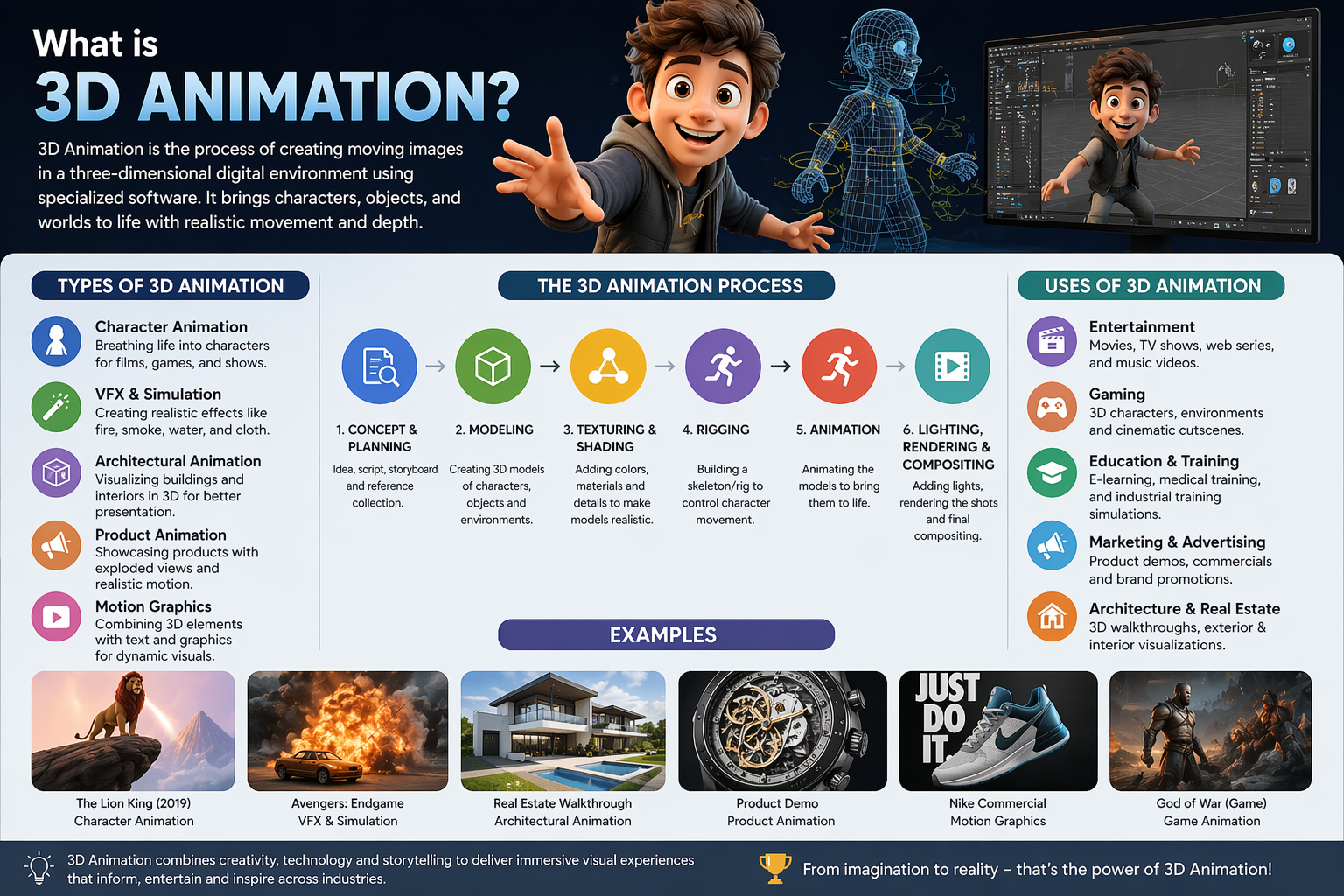
3D animation is the process of creating moving images in a three-dimensional digital environment using computer software. Unlike 2D animation, 3D animation adds depth, making characters and objects appear more realistic and lifelike. It is widely used in films, video games, advertising, architecture, education, and medical visualization. The process of creating 3D animation includes stages such as concept development, 3D modeling, texturing, rigging, animation, lighting, rendering, and post-production. Popular types of 3D animation include character animation, mechanical animation, motion graphics, visual effects (VFX), and architectural animation. With the rise of technologies like VR, AR, and real-time rendering, 3D animation continues to grow as one of the most important creative fields in digital media.
3D animation has become one of the most powerful visual storytelling tools in modern media. From blockbuster movies and video games to advertisements, architecture, and medical simulations, 3D animation is everywhere. Whether it's the lifelike characters in animated films or the immersive worlds in gaming, 3D animation helps bring imagination to life.
In simple terms, 3D animation is the process of creating moving images in a three-dimensional digital environment. Unlike traditional 2D animation, where objects only have height and width, 3D animation adds depth, making characters and objects look realistic and interactive.
In this guide, we will explore what 3D animation is, its types, the animation process, and its real-world uses with examples.
What is 3D Animation?
3D animation is a technique used to create three-dimensional moving objects using computer software. These objects exist in a virtual space where they can be rotated, scaled, and moved just like real-world objects.
Animators create digital models of characters, objects, and environments and then use specialized software to animate them frame by frame.
Popular software used in 3D animation includes:
- Autodesk Maya
- Blender
- Cinema 4D
- 3ds Max
- Houdini
These tools allow animators to design detailed characters, add textures, control lighting, and simulate natural movements.
For example:
- Animated movies like Toy Story use 3D animation for characters and environments.
- Video games use 3D animation to make characters move realistically.
- Architects use 3D animation to create virtual walkthroughs of buildings before construction.
Because of its realistic appearance and flexibility, 3D animation is widely used across industries.
Key Features of 3D Animation
Before understanding its types and process, it helps to know what makes 3D animation unique.
1. Three-Dimensional Environment
Objects in 3D animation have height, width, and depth, making them appear realistic and lifelike.
2. Realistic Lighting and Textures
Advanced rendering techniques allow animators to create realistic lighting, shadows, reflections, and textures.
3. Camera Movement
Virtual cameras can move freely around the scene, just like a real camera.
4. Physics Simulation
3D animation software can simulate gravity, collision, cloth movement, and fluid dynamics.
5. Character Rigging
Characters are given a digital skeleton so they can move naturally.
Types of 3D Animation
There are several types of 3D animation used in different industries. Each serves a unique purpose.
1. Character Animation
Character animation focuses on bringing digital characters to life through movement, expressions, and body language.
This type of animation is commonly used in:
- Animated films
- Video games
- TV shows
- Short films
Animators use techniques such as rigging, keyframing, and motion capture to create natural movements.
Example:
- Animated movies like Toy Story, Frozen, and Shrek use character animation to create expressive characters.
Character animation is one of the most challenging areas because animators must make characters feel emotional and believable.
2. Mechanical Animation
Mechanical animation focuses on machines, tools, and technical products.
It is widely used in:
- Engineering demonstrations
- Product marketing
- Industrial training
- Manufacturing simulations
Example:
A car company may use mechanical animation to show how an engine works internally.
This type of animation emphasizes precision and technical accuracy rather than emotional storytelling.
3. Motion Graphics
Motion graphics combine 3D animation with graphic design elements.
It is commonly used for:
- Advertising
- Corporate videos
- Explainer videos
- TV channel branding
Example:
A company launching a smartphone may create a 3D motion graphics video showing the phone rotating, zooming, and highlighting its features.
Motion graphics focus more on visual impact and presentation.
4. Visual Effects (VFX)
Visual effects involve combining 3D animation with live-action footage.
This is commonly used in movies, television shows, and streaming platforms.
Examples include:
- Explosions
- Fantasy creatures
- Superhero powers
- Futuristic environments
Example:
Movies like Avatar and Avengers heavily use VFX powered by 3D animation.
VFX artists integrate animated elements seamlessly into real-world scenes.
5. Architectural Animation
Architectural animation is used to create realistic visualizations of buildings and spaces.
It is commonly used in:
- Real estate marketing
- Architecture presentations
- Urban planning
Example:
A real estate developer may show a 3D walkthrough of a luxury apartment before construction begins.
This helps buyers visualize the final project.
The 3D Animation Process
Creating a 3D animation involves several stages. Each stage is important to produce a high-quality final result.
1. Concept and Storyboarding
Every animation project begins with an idea.
Artists develop:
- Story concepts
- Scripts
- Character ideas
- Visual styles
Storyboards are then created to plan the scenes visually.
A storyboard acts like a comic strip showing how the animation will unfold.
2. 3D Modeling
3D modeling is the process of creating digital objects and characters.
Artists use modeling tools to design:
- Characters
- Props
- Environments
- Vehicles
These models are built using polygons, edges, and vertices.
The more detailed the model, the more realistic the animation can look.
3. Texturing and Shading
Once the models are created, artists add textures and materials.
Textures define the surface appearance of objects such as:
- Skin
- Metal
- Fabric
- Wood
- Glass
For example, a character’s skin texture may include wrinkles, pores, and color variations.
This stage helps objects look more realistic.
4. Rigging
Rigging is the process of adding a digital skeleton to a 3D model.
This allows characters to move naturally.
For example, a character rig includes:
- Arm joints
- Leg joints
- Spine controls
- Facial controls
Rigging makes it possible to animate complex movements such as walking, running, or facial expressions.
5. Animation
This is the stage where movement is created.
Animators manipulate the rigged models using techniques like:
Keyframe Animation
Animators define important positions of objects at specific frames.
The software then calculates the movement between those frames.
Motion Capture
Motion capture records real human movement and applies it to digital characters.
This technique is commonly used in films and video games.
Example:
Actors wear special suits with sensors that capture their movements.
6. Lighting
Lighting helps set the mood and realism of the scene.
Artists place virtual lights to simulate:
- Sunlight
- Indoor lighting
- Shadows
- Reflections
Proper lighting makes scenes look cinematic and believable.
7. Rendering
Rendering is the process of converting the 3D scene into final images or video frames.
During rendering, the computer calculates:
- Lighting
- Shadows
- Reflections
- Textures
- Camera angles
Rendering can be time-consuming because each frame requires complex calculations.
High-end animated movies sometimes take several hours to render a single frame.
8. Post-Production
The final stage involves editing and adding finishing touches.
This includes:
- Color correction
- Visual effects
- Sound design
- Background music
- Final video editing
After post-production, the animation is ready for release.
Uses of 3D Animation
3D animation is used in many industries beyond entertainment.
1. Film and Entertainment
The film industry relies heavily on 3D animation for:
- Animated movies
- Visual effects
- Fantasy worlds
- CGI characters
Examples include:
- Toy Story
- Frozen
- Avatar
These films demonstrate the storytelling power of 3D animation.
2. Video Games
Modern video games depend on 3D animation for:
- Character movements
- Environment design
- Action sequences
Examples include:
- Open-world adventure games
- Racing games
- Simulation games
Game engines like Unreal Engine and Unity use real-time 3D animation.
3. Advertising and Marketing
Brands use 3D animation to create eye-catching advertisements.
Examples include:
- Product demonstrations
- Promotional videos
- Social media ads
A smartphone brand may use 3D animation to show internal components and design features.
4. Architecture and Real Estate
3D animation allows architects to show virtual building walkthroughs.
This helps clients visualize:
- Room layouts
- Interior design
- Lighting
- Landscapes
It improves decision-making before construction starts.
5. Medical and Scientific Visualization
In the medical field, 3D animation is used to explain complex topics such as:
- Human anatomy
- Surgical procedures
- Drug interactions
- Medical training
For example, doctors may use animation to demonstrate how a heart surgery works.
6. Education and E-Learning
Educational institutions use 3D animation to make learning more engaging.
Examples include:
- Science simulations
- Engineering demonstrations
- Historical reconstructions
Students can understand complex subjects more easily with animated visuals.
Advantages of 3D Animation
3D animation offers several benefits.
High Realism
3D models can look almost identical to real-world objects.
Creative Freedom
Artists can create imaginary worlds, creatures, and effects that would be impossible to film in reality.
Reusability
Once a 3D model is created, it can be reused in multiple scenes.
Flexibility
Changes can be made without reshooting scenes.
Future of 3D Animation
The future of 3D animation is rapidly evolving due to emerging technologies such as:
- Artificial Intelligence
- Virtual Reality (VR)
- Augmented Reality (AR)
- Real-time rendering
- Metaverse environments
These technologies are expanding how 3D animation is used in entertainment, gaming, training, and virtual experiences.
As demand grows, the need for skilled 3D animators continues to rise worldwide.
Conclusion
3D animation is a powerful digital technique that transforms ideas into realistic visual experiences. By combining creativity with advanced computer technology, animators can create lifelike characters, immersive environments, and engaging stories.
From movies and games to architecture, medicine, and education, 3D animation has become an essential tool across industries.
Understanding the types, process, and applications of 3D animation helps reveal how much effort and creativity go into the animated content we see every day.
As technology continues to advance, 3D animation will play an even bigger role in shaping the future of digital media and storytelling.
FAQs
1. What is 3D animation?
3D animation is the process of creating moving images in a three-dimensional digital space using computer software. It allows objects and characters to move realistically with height, width, and depth.
2. How does 3D animation work?
3D animation works by creating digital models of objects or characters and animating them using techniques like rigging, keyframing, lighting, and rendering to produce realistic motion.
3. What are the main types of 3D animation?
The main types of 3D animation include character animation, mechanical animation, motion graphics, visual effects (VFX), and architectural animation.
4. What software is used for 3D animation?
Popular 3D animation software includes Autodesk Maya, Blender, Cinema 4D, Houdini, and 3ds Max.
5. What is the process of creating 3D animation?
The 3D animation process typically includes concept development, storyboarding, 3D modeling, texturing, rigging, animation, lighting, rendering, and post-production.
6. Where is 3D animation used?
3D animation is used in films, video games, advertising, architecture, education, medical visualization, product design, and virtual reality experiences.
7. What is the difference between 2D and 3D animation?
2D animation works on a flat surface with height and width, while 3D animation adds depth, allowing objects to move in a realistic three-dimensional space.
8. Is 3D animation a good career?
Yes, 3D animation is a growing career field with opportunities in film production, gaming, advertising, VFX studios, and digital media industries.
9. What skills are needed to become a 3D animator?
Important skills include creativity, storytelling, knowledge of animation software, understanding of motion and timing, and basic design principles.
10. How long does it take to learn 3D animation?
Learning 3D animation basics can take a few months, while mastering professional animation skills may take 1–3 years depending on training and practice.


